
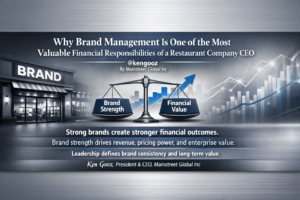
 Many restaurant CEOs view brand management as a marketing function.
In reality, it is one of the most important financial responsibilities in the organization.
A restaurant brand influences virtually every aspect of business performance, including guest traffic, pricing power, franchise development, customer loyalty, investor confidence, and long-term enterprise value.
Simply put, strong brands create stronger financial outcomes.
Brand Strength Drives Revenue
Consumers often choose restaurants based on trust, familiarity, and consistency.
A well-managed brand creates confidence in the guest experience before a customer even walks through the door.
When guests trust a brand, they visit more frequently, spend more confidently, and are more likely to recommend the business to others.
Over time, this translates directly into higher sales and stronger revenue performance.
Strong Brands Create Pricing Power
One of the greatest financial advantages of a strong brand is the ability to command premium pricing.
Guests are often willing to pay more when they believe they are receiving a consistent experience, reliable quality, and strong value.
Brands that maintain this trust are typically less vulnerable to competitive discounting and price-based competition.
Brand Consistency Supports Franchise Growth
For franchise organizations, brand management becomes even more important.
Franchisees invest in systems they believe customers will recognize and trust.
The stronger and more consistent the brand, the easier it becomes to attract franchisees, secure development agreements, and expand into new markets.
In many respects, the brand becomes one of the most valuable assets a franchise company owns.
Brand Value Influences Enterprise Value
Investors rarely evaluate restaurant companies solely on current earnings.
They also evaluate future earnings potential.
Strong brands create confidence in future cash flows, future growth opportunities, and future market expansion.
As a result, companies with strong brand equity often command greater investor interest and higher valuations than organizations with similar revenues but weaker market positioning.
The CEO’s Role
Brand management cannot be delegated entirely to marketing departments.
The most successful restaurant CEOs understand that brand standards, guest experience, operational consistency, franchisee performance, culture, and leadership all contribute to brand strength.
Every operational decision ultimately affects the brand.
And every brand decision ultimately affects financial performance.
The Bottom Line
Brand management is not simply about logos, advertising, or social media campaigns.
It is about protecting and enhancing one of the company’s most valuable financial assets.
The restaurant organizations that consistently create the greatest long-term value are often those whose leadership teams understand the direct connection between brand strength, profitability, and enterprise value.
Because in today’s restaurant industry, strong brands do more than attract customers.
They create financial value.
Executive Perspective
The most valuable restaurant brands are rarely built through marketing alone. They are built through leadership, operational consistency, guest trust, and disciplined brand management. For CEOs, protecting and strengthening the brand remains one of the most important investments they can make in the future value of the organization.
Currently available to support select restaurant, hospitality, franchise development, and growth-focused projects throughout Canada, Southeast Asia, and Europe through executive advisory, interim leadership, and project-based engagements.
Ken Gooz President & CEO Mainstreet Global Inc. mainstreetglobal@gmail.comMainstreetGlobal.ca