 For many years, restaurant franchising was often measured by one primary metric: the number of new locations opened.
The assumption was simple. More stores meant more success.
Today, that mindset is changing.
While franchise growth remains strong across North America, many restaurant companies are discovering that sustainable growth is far more important than rapid growth. Investors, lenders, franchisees, and leadership teams are placing greater emphasis on profitability, operational consistency, and long-term scalability than on expansion alone.
The most successful franchise organizations are no longer asking, “How many locations can we open?”
They are asking, “How many successful locations can we support?”
This distinction is becoming increasingly important.
Many emerging restaurant brands reach a point where demand for expansion begins to outpace the infrastructure required to support it. Franchise sales accelerate, new markets are entered, and development agreements are signed. However, without the proper systems, leadership, training, financial controls, and brand standards in place, growth can quickly create operational strain.
The reality is that growth magnifies both strengths and weaknesses.
Strong systems become stronger.
Weak systems become more visible.
As a result, sophisticated restaurant companies are investing more heavily in the foundations that support growth. This includes operational procedures, franchise support systems, financial reporting, leadership development, supply chain management, technology platforms, and quality assurance programs.
These investments may not generate headlines, but they create the infrastructure necessary for long-term franchise success.
Another noticeable shift is occurring among franchise investors and prospective franchisees themselves.
Today’s franchise candidates are conducting far greater due diligence before making investment decisions. They want to understand store-level profitability, return on investment, occupancy costs, labour efficiency, support structures, and the long-term viability of the franchise system.
Brand recognition remains important, but strong unit economics are increasingly becoming the deciding factor.
For restaurant founders, this creates an important opportunity.
Companies that focus on building disciplined growth strategies, maintaining brand standards, supporting franchisee success, and protecting unit-level profitability are often better positioned for long-term expansion than organizations pursuing growth for growth’s sake.
In many ways, the restaurant franchise industry is entering a more mature phase.
Growth remains important.
Expansion remains important.
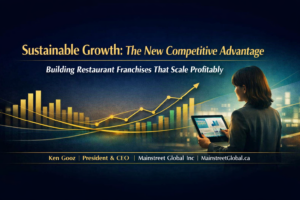
But sustainable growth is becoming the new competitive advantage.
The restaurant brands that will lead the next decade are likely to be those that combine entrepreneurial ambition with operational discipline, financial clarity, and a commitment to supporting franchisee success at every stage of development.
Because in franchising, growth is not simply about opening more locations.
It is about building a system that can successfully support them.
Looking Forward
Every restaurant brand has unique growth objectives, challenges, and opportunities. The most successful organizations recognize the value of experienced guidance during critical stages of development, helping leadership teams move forward with greater clarity, confidence, and structure.
If your organization is evaluating franchise development, market expansion, executive advisory services, or growth-related initiatives, I welcome the opportunity for a confidential discussion regarding your objectives and future plans.
Ken Gooz President & CEO Mainstreet Global Inc. mainstreetglobal@gmail.comMainstreetGlobal.ca