
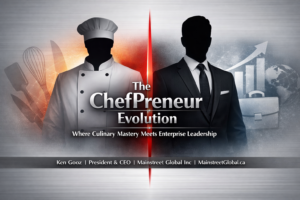
The ChefPreneur Evolution: From Kitchen to Enterprise
By Ken Gooz, President & CEO, Mainstreet Global Inc.
In Part 1, we introduced the ChefPreneur — chefs who think like operators, operators who think like brand builders, and creators who turn flavor into enterprise value.
But mindset is only the beginning. The real transformation happens when a chef‑led restaurant evolves from one remarkable location into a repeatable, investable, multi‑unit brand.
That’s where art meets architecture. Where creativity meets capital. Where passion becomes a platform.
1. The Turning Point: When Demand Outgrows the Founder
Every chef‑led brand hits a moment when success creates pressure: full dining rooms, investor calls, expansion offers.
The challenge? The magic that built the brand — the chef — can’t be cloned.
ChefPreneurs make the shift: From being the center of the business → to designing the business itself. They step out of the kitchen so others can step in confidently.
2. The ChefPreneur Playbook: Codifying Excellence
Scaling isn’t dilution — it’s discipline. ChefPreneurs protect creativity through structure.
a) Signature Flavor System Define specs, prep timelines, techniques, and presentation standards. Protect the integrity of the menu.
b) Guest Journey Script Hospitality isn’t improvisation — it’s a rhythm. Every sensory moment is designed.
c) Culture Bible Culture doesn’t scale by accident. It’s named, taught, reinforced, and modeled.
d) Leadership Ladder Develop sous chefs and GMs into leaders who think like founders — without needing the founder.
e) Financial Clarity ChefPreneurs know their numbers: prime costs, contribution margins, payback timelines. Growth follows intentional economics.
3. Investor‑Ready: When Creativity Meets Credibility
Investors look for three signals:
- Proof of Concept — strong AUV, unit economics, repeat traffic.
- Transferable Systems — not corporate, just repeatable.
- Founder Clarity — a story, a culture, a system, a model.
ChefPreneurs aren’t selling a restaurant — they’re selling a scalable brand.
4. The ChefPreneur Advantage
The market is shifting toward authenticity and operational discipline. Consumers want brands with soul. Investors want culture‑led growth. Talent wants meaningful leadership.
ChefPreneurs deliver all three — the triangle of Authenticity + Discipline + Storytelling.
5. What’s Next
The next decade belongs to culinary founders who scale intentionally: Chef‑led franchise systems, fast‑casual concepts, global partnerships, and investor‑backed incubators.
The chef is no longer just the creator — the chef is the enterprise value engine.
Final Thought
You don’t have to choose between creativity and growth. You can have both — if you build with intention.
Your recipes are teachable. Your culture is transferable. Your brand is scalable. Your story is an asset.
The market doesn’t want the chef to disappear. It wants the chef to lead — at a higher level.